
Jan 29, 2026
Why Crypto UX is Broken
And How Agents Might Fix It


Agents could remove complexity from crypto
Why First-Time DeFi Users Abandon Transactions: The Crypto Onboarding Problem
According to data from Dune analytics, roughly 73% of first-time DeFi users abandon their transaction after they encounter their first error or failure. A significant portion of those new users (37%) only perform a single transaction, while 81% perform less than 10, showing clear markers for a high drop-off rate with no immediate or long-term retention.
Looking at 2026 and the current landscape, despite continued growth and an estimated market cap of 3.23 Trillion, UX within Crypto and the DeFi space as a whole has not become any easier to navigate. A quick google search brings up an abundance of articles highlighting the simple fact that blockchain and crypto has been driven by and for early adopters, tech innovators and enthusiasts, their priority being to realise the value and potential of the technology.
Core UX Challenges in Web3: Why Design Alone Can’t Fix Blockchain Complexity
The problem resides on multiple levels of the web3 user experience, which is why applying good design practices to just one layer does not solve the core issue. If you’re relying on good UX/UI on just the visual layer, whether it’s an app or web based platform - applying solid information hierarchy, clear inputs and controls, strong visual cues etc, that still leaves a major barrier for the average user who does not understand the underlying framework of how blockchain works. So the functional, access and technology layers still act as blockers for the user when they don’t see or understand the connection between wanting to send a token to someone, and how that fits into the access layer which requires the correct wallet address on the correct chain, or the technology layer and the fees (gas) required to facilitate the transaction and ensure it’s completed.
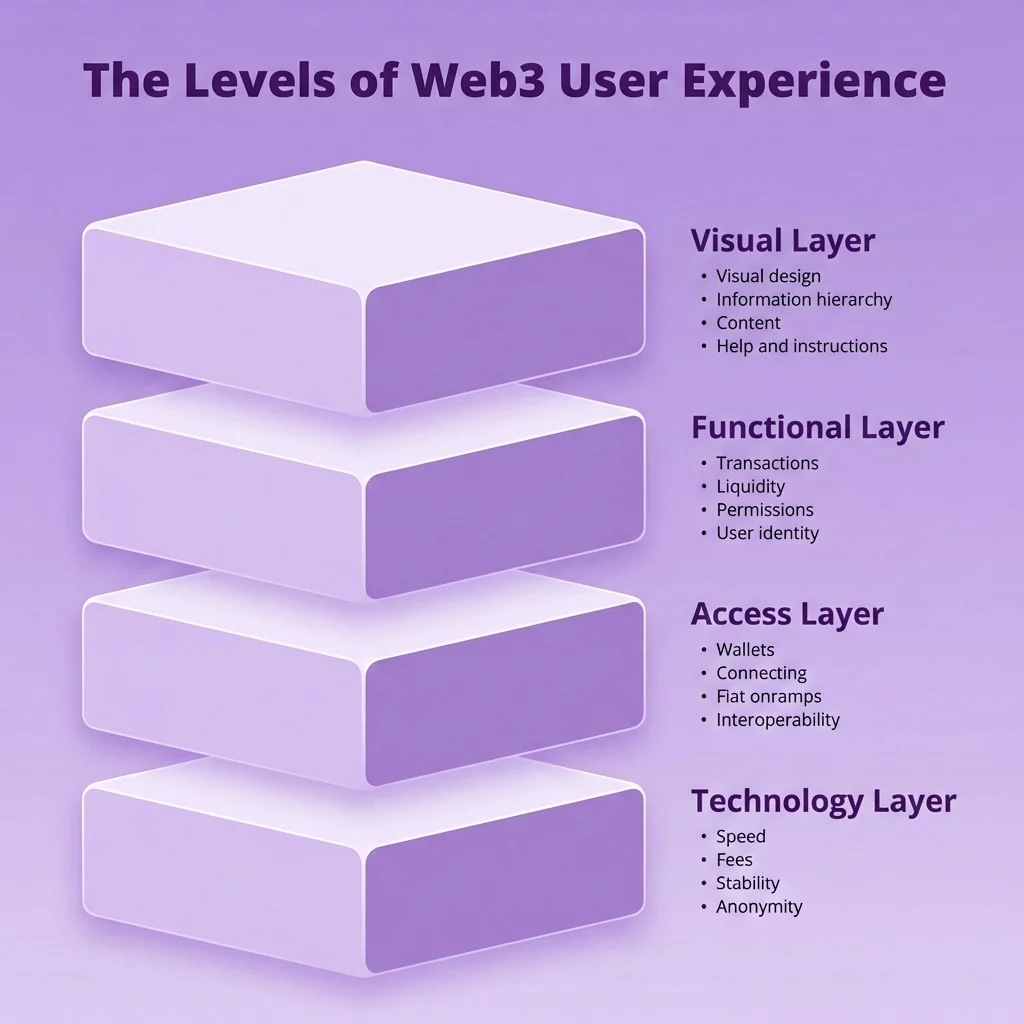
All these layers add complexity beyond what the user can see on the interface, and without a clear understanding of these layers and the relationship between them, add to that having terminology like wallets, seed phrases, gas, wrapped tokens - you’re speaking a completely foreign language, no matter how well thought out the interface might be or the effort put into structuring the experience.
I compare it to having the latest, top-of-the-line, smart electric vehicle. It’s an automatic, so no need to worry about switching gears or dealing with a clutch, it has a nice big digital display to inform you of everything going on inside and outside the car - speed, fuel, battery charge, tyre pressure, location, distance to your destination etc. but what happens when you ask someone to take the wheel who doesn’t know how to drive? Blockchain, crypto and by extension web3 is continually evolving and extremely deep in terms of its functional and technical complexity. So achieving mass adoption either requires users to learn and become comfortable with that complexity — or for us to hide it. This is where the real problem begins.
How AI Agents Could Simplify Crypto UX and Guide Users Through DeFi
How might agents be able to solve this problem? Instead of asking someone who doesn’t know how to drive to get behind the wheel of a technically impressive, cutting edge vehicle, what if we gave them a chauffeur? They don’t need to worry about the mechanical aspect of the car, how it works or the right terminology for the various components and features. All they need to know is where they want to go i.e what it is they want to achieve, the chauffeur will handle the execution while being on-hand to explain and provide clarity for any questions the rider might have.
Agents are still evolving, and we are seeing how LLMs can take in natural language requests and compile this into code. Pairing this with DeFi and Blockchain, that code can directly express and be executed as primitives for financial transactions. This speaks to one of crypto’s core challenges — the knowledge gap that design alone can’t solve. Agents could collapse multiple layers into a single natural-language interface, removing the complexity and guiding users by handling the execution for them. The real question is whether AI can reach a level of trust where users are willing to rely on it.
How AI Agents Could Simplify Crypto UX and Guide Users Through DeFi
I think this is going to depend on the shifting narrative around AI. Right now many people are happy to experiment and ‘play’ with AI to create images or videos, or as a smarter Google. When it comes to sensitive data and handling finances, trust evaporates fast. People are fine when the stakes are low and there’s no risk or loss tied to them entering some prompts but when it’s their life savings or hard earned salary suddenly their trust in a faceless machine or entity becomes very fragile and can be replaced with animosity.
The turning point will come with reliability. Systems with reputational scoring and strong safe guards are what’s going to tip this scale, once people can see real-world evidence of AI being used and successfully providing value and returns on investments then they will be open to taking a chance, no one wants to be first but they also don’t want to be last either and that’s where AI adoption accelerates.
Written by: Philip O'Sullivan - UI/UX Lead
Philip leads UI/UX within the Platform team at Finance District, focusing on creating clear, intuitive product experiences that support cross‑team initiatives and developer workflows.
To continue the conversation, join our Discord community, follow us on X, or explore our documentation to learn more.

